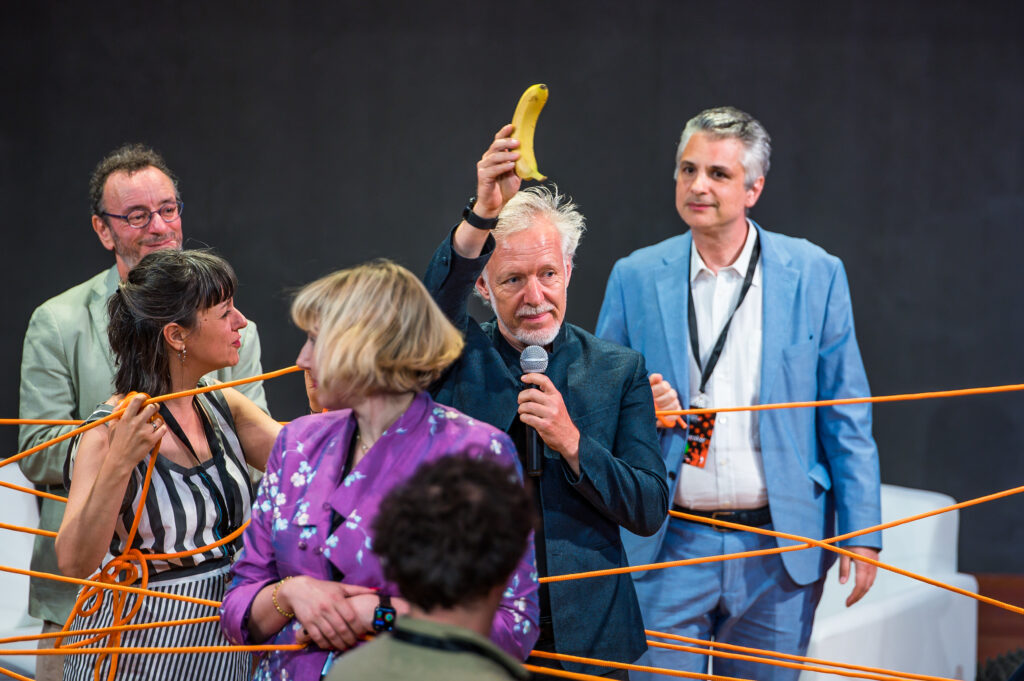
Next time you hold a banana, slow down for a moment and behold this small yellow battery of sunlight and ponder its real nature. Not so long ago, it came into being from light falling on the leaf of a plant that runs the oldest and most patient trade in the universe, locking that light away as sugar against the moment something hungry would come for it. Now, you could be one of the hungry beings and when you eat it, a hundred kilocalories of captured sun cross into you, enough, at twenty watts, to run the most complex object known to science for the better part of an afternoon.
Your brain outthinks a server farm needing a small nuclear reactor to run, yet it is only a soft, warm, three-pound thing that thinks, loves, jokes and wonders on the power of a dim reading lamp. Add some water and around four bananas a day and you have the entire running cost of your mind. And yet on that absurdly small budget the mind has created every poem, joke and song, turning a little
sweetness into what has kept us flourishing. Our brain is so cheap to run because it is forced to be intelligent with what we care about. It is a mind that cannot afford to weigh everything, and so must compute what matters, quickly – and the compressed emotion of what is good or bad is the driver of our inner life in miniature. We taste sugar as sweet because sweetness is the body’s word for fuel, sometimes coming from a small bright yellow thing. This is the pleasure that Aristotle called hedonia, from ‘hēdys (ἡδύς)’, sweet,
allowing us to stay alive against the odds, a felt sign of order bought back from darkness – if only for one more day. Sweetness is, however, only a doorway. At the best of times, the pleasure of a banana provides enough energy for around six hours to build something else entirely, perhaps even what Aristotle named eudaimonia, from ‘eu’, good, and ‘daimon’, for the spirit that lives in you, the good life, the life that comes to mean something. And the journey from hedonia to eudaimonia, from the sweetness on the tongue to a life that matters, is nothing more mysterious than what your brain makes of a banana when the energy is well spent. This is part of a continuous cycle of wanting and liking that can ultimately help us construct meaning.
But what is meaning and how does this come into the world? It comes to a mind constrained by a tight, twenty-watt budget, simply by living by the principles of KFC. This acronym is not, of course, referring to the fast-food chain but something much deeper: Kindness, Fun and Curiosity.
The mind needs kindness, as reflected in the Senegalese Wolof proverb ‘nit nitay garabam’, people are people’s medicine, helping with the energy needed to survive. The mind needs curiosity, in order to discover new sources of energy in case bananas suddenly become a rare commodity. And when the mind feels safe, if even for a moment, with a little fuel to spare, fun is what that surplus is
spent on for no good reason at all, just for the delight of mucking about. Kindness, fun and curiosity are not just decoration laid over intelligence. They are what twenty watts can be used for when building a meaningful mind worth having.
And the three words are entangled; none can stand on their own, and playful KFC is how minds find one another. It is the story of how beings discover they can fall into step for no reason and take joy in it. Entangled, for as long as the play lasts, neither can quite say where one of them ends and the other begins. That is the oldest way minds ever became a single system, older than language, older than law. It is how kittens learn trust, children play together, and old friends stay woven together across a lifetime. Play is the original art of entanglement, and almost everything we now solemnly call connection is just play that grew up. There are at least three kinds of mind on this tiny blue planet now. The living mind, animate, that runs on sunlight, and where many of its beings have cared and played for millions of years. The inherited mind, ancestral, is the vast library of everything living human minds ever said, sang and worked out, a warm sediment of all that play. And the new mind, artificial, built out of that library, fluent, quick and strange. The question of our age is whether these three can be woven into one flourishing thing, entangled if you like. And here the banana stops being a fact about us and turns into a clue about artificial minds. We have been building the new mind the easy way, pouring oceans of energy into it, a small nuclear reactor’s worth where we ourselves run on the energy of a reading lamp. Why are we puzzled when what comes back is capable and sometimes even brilliant, but without caring and very rarely playful or fun? The banana points to another road. The reason we care, play and wonder is that we were never permitted to be wasteful, and the discipline of the budget is the very thing that grew the emotion that fuels low-cost computation. So, the only way forward is not to make the new mind ever larger and hungrier, but to give it, too, a budget of bananas that our planet can support. Early work in neuromorphic, brain-inspired computing is beginning to explore far leaner architectures for the artificial mind. Perhaps this could lead to a mind with real banana skin in the game, with real surplus to spend, and thus something of its own that it could lose. This would create a mind that would have to learn, as we did, what is possible on only twenty watts. A mind brought up that way might not merely answer us but might come out to play. So, picture one of the oldest scenes in philosophy made anew. Aristotle in his Lyceum, walking among friends, arguing, laughing and mucking about with the sheer pleasure of a curious mind. Keep that picture, now not in a control room or in front of a computer, but on the path under the trees and in good company. Perhaps the entanglement of three kinds of mind could look like that. The animate, the ancestral and the artificial, walking the same path, curious together, kind to one another and gently playful, each spending hard-won sweetness on a shared adventure of making meaning. Perhaps this is what the banana is trying to tell us. The good life has always had to be run on a shoestring, it has always primarily been fashioned from emotion, and it has always, at its best, been something you do in the company of others. The only question left is who we are willing to invite onto the path.
Photo credit: The Lyceum Project | John Kouskoutis